
How to divide household chores fairly as a couple
A practical way to split housework as a couple: list every job, count the invisible ones, choose a method that suits you both, and check in before it festers.
The Dolceora team5 min read
Few things cause as many small, simmering arguments as housework. Not because anyone wants an unfair split, but because most couples never actually agree on one. The jobs fall to whoever notices them first, and after a while one of you is noticing a lot more than the other.
This guide walks through a way to split chores that both of you can live with: what to list, how to account for the jobs nobody sees, a few ways to divide them, and how to keep it from sliding back.
Start by listing everything
You can’t split what you haven’t named. Sit down together for half an hour and write down every regular job in your household. Go room by room, then think through a typical week, month and year.
It’s usually longer than either of you expects. A starting point:
- Daily: cooking, washing up or stacking the dishwasher, tidying, feeding pets.
- Weekly: groceries, laundry, cleaning the bathroom, vacuuming and mopping, bins out and back in, changing the sheets.
- Monthly or so: paying bills, cleaning the fridge, the oven, the gutters, mowing, washing the car.
- A few times a year: car rego and servicing, insurance renewals, booking the dentist, the big spring clean, tax time.
Count the invisible work
The jobs on that list that take time are easy to see. The ones that take thought are not. It’s often called the mental load: noticing that the milk is low, remembering the vet appointment, knowing which bin goes out this week, keeping track of whose birthday is coming up and buying the card.
When you write the list, add these as jobs in their own right:
- Planning meals for the week, not just cooking them.
- Keeping track of what’s running out and putting it on the shopping list.
- Booking appointments and keeping on top of renewals.
- Remembering birthdays and events, and organising presents.
- Organising social plans with friends and family.
A useful rule of thumb: the person who does a job should also own remembering it. “I’ll take the bins” means you know when bin night is, not that you’ll take them out when asked.
Choose a way to split it
There’s no single right split. What matters is that you both agree it’s fair, and fair doesn’t always mean 50/50 by the clock. If one of you works much longer hours, or one of you does the morning school run, that counts too. A few methods couples use:
By preference
Each of you goes through the list and marks the jobs you don’t mind, the ones you hate and the ones you’re indifferent to. You’ll often find that one person’s worst chore is the other’s easy win. Start by giving each of you the jobs you prefer, then divide what’s left.
By ownership
Rather than splitting tasks, split areas. One of you owns the kitchen and groceries; the other owns laundry, bathrooms and bins. Owning a whole area means owning its mental load too, so there’s less “did you remember to…?”
By rotation
For the jobs neither of you wants, take turns. Alternate weeks on the bathroom, or swap the hated jobs every month. It’s simple and nobody gets stuck with the worst job forever.
By time
If the arguments are really about who does more, estimate how long each job takes a week and aim for a split you both think is fair, taking work and other commitments into account. It sounds clinical, but putting numbers on it often ends a disagreement quickly.
Most couples end up with a mix: ownership for the big areas, preference for the rest, and rotation for the jobs nobody likes.
Write it down where you’ll both see it
An agreement you made over dinner three months ago won’t hold. Put it somewhere you both look:
- Recurring jobs on a shared calendar: bin night, the fortnightly mow, the monthly bill run. A repeating event for each means nobody has to remember.
- One-off jobs on a shared to-do list, with whose job each one is and a due date if there’s a deadline, like the car rego.
- The agreement itself somewhere you can find it, even just a note on the fridge.
Check in before it festers
Resentment about housework builds slowly. A short, regular check-in catches it early. If you already have a weekly check-in, add one question to it: “Is the split still working for both of us?”
When it isn’t, change it. Jobs shift when work changes, when someone’s injured or when a baby arrives. The split you agreed on when you moved in together probably won’t still fit five years later.
A few things that help keep the conversation easy:
- Talk about the system, not the person. “The dishes are piling up, can we change how we do them?” goes better than “you never do the dishes.”
- Accept different standards, within reason. If it’s your job, it’s done your way. If it’s theirs, let them do it their way.
- Say thanks. It costs nothing and it makes the work feel shared.
How Dolceora helps
Dolceora’s shared to-do list was built for this. Give each task to yourself, your partner or both of you, add a due date to the ones with a deadline, and put the account number or the plumber’s name in the notes. Filter to just your own tasks when it’s time to get things done, and see what’s left on your Home screen.
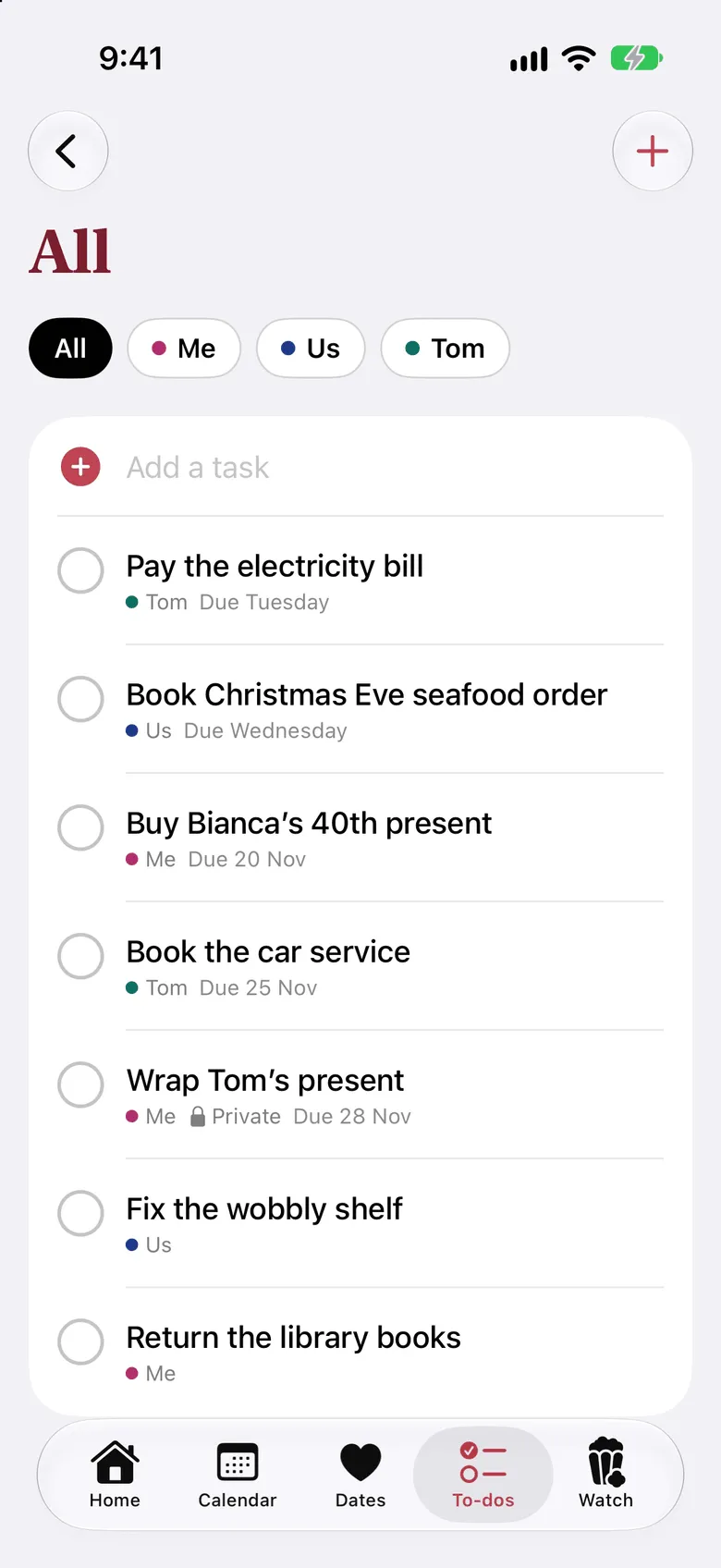
Repeating jobs, like bin night or the fortnightly mow, go on the shared calendar as a repeating event, in the colour of whoever owns them. And the present-buying for your partner’s birthday? Make that task private, and only you can see it.
The short version
- List every job, including the ones that are mostly thinking.
- Agree on a split you both think is fair, by preference, area, rotation or time.
- Whoever owns a job owns remembering it.
- Write it down somewhere you both see.
- Check in regularly, and change it when life changes.